


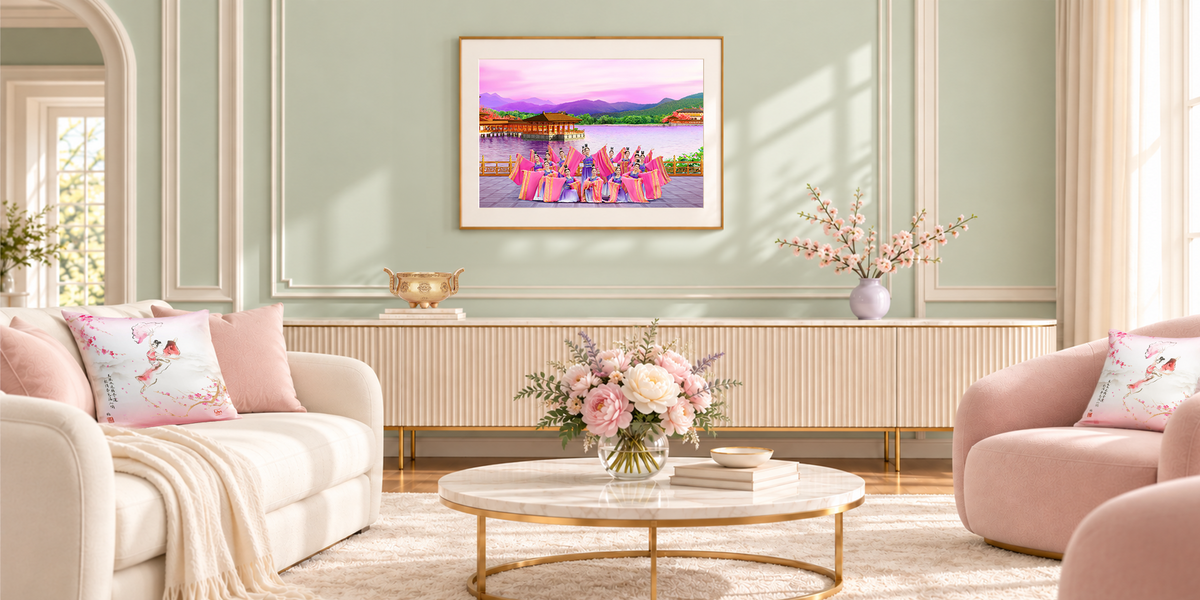


Tang Dynasty Grace: Wide Sleeves Like Those of Immortals
"Eyes clear as autumn waters, faces like lotus blossoms—the court ladies of the Tang, their wide sleeves lifting in the wind, gentle and graceful, yet unable to conceal an air of stately splendor." This is the program description of Tang Dynasty Grace, a women's dance from Shen Yun's 2018 season. In a few minutes on stage, it captures the essence of an entire golden age. Now Shen Yun Collections has released a giclée print of this amazingly graceful dance.
How did the people of the Tang come by such grace? The answer may lie in the period itself. Chang'an was then the grandest capital in the world, and the Daming Palace covered an area more than four times that of the Forbidden City. It was a society defined by a high degree of refinement and civilization, such that envoys would come from far away to visit the Emperor in Chang’an. Meanwhile, the rich traditions of Confucianism, Buddhism, and Daoism flourished side by side. The imperial house honored Laozi as its ancestor and made Daoism the state religion; Xuanzang journeyed to India and returned to Chang’an with the scriptures that spread Mahayana Buddhism through China; and the Confucian classics remained the foundation of a scholar's self-cultivation and the imperial examinations. Three traditions at their height together shaped the spirit of the era.
Legend tells that Emperor Xuanzong once traveled to the Moon Palace in a dream, where he heard celestial music, and upon waking composed the poem Rainbow Skirt and Feathered Robe. The people of that age believed that the most beautiful music and dance came from the heavens.
Wide Sleeves Like Those of Immortals
The wide sleeve is the most distinctive feature of the elegant clothing known as Hanfu. The sleeve is broad at the opening, flowing along its length, falling like cloud and lifting like wings. In ancient China it was no ordinary garment. Those who worked the land wore narrow sleeves for ease of movement; only nobles, scholars, and officials, or those attending sacrifices, court assemblies, and festivals, put on wide-sleeved ceremonial dress. The breadth of the sleeve was not for extravagance, but to carry the weight of a civilization built on rites and music.
Traditional Chinese dress favors a crossed collar closing to the right and a sash at the waist, cut to follow the body rather than confine it. Such clothing moves like water: in motion it stirs the air, at rest it holds the dew. The Book of Changes speaks of rulers who "let their robes hang down, and the realm was well governed"—from the earliest times, clothing was never merely a covering, but a symbol of the order of heaven and earth.
Hanfu itself is said to have drawn its inspiration from the garments of celestial beings—the rainbow skirts and feathered robes of legends. To the ancients, who revered heaven and the divine, immortals dwelt above the clouds, their robes woven from rainbow mist, light and free. The most beautiful clothing on earth was a reflection of what was worn above.

What the Painting Shows
More than a dozen Tang court ladies form the heart of this work. Their wide-sleeved pink gowns open broadly at the arm, with orange-gold brocade bordering the collars and cuffs, over skirts that fade from violet to pale. Those in front bend at the knee with sleeves drawn in; those behind rise up, arms extended like wings; and at the very back, one lifts a hand skyward. Arranged high and low, the figures answer one another like the petals of a flower just opening.
Here the wide sleeve becomes an extension of the arm, tracing long arcs through the air like a single unbroken brushstroke in an ink painting. Though the image is still, those lines seem to be moving yet.
Behind the dancers runs a golden carved balustrade, and beyond it an open lake with violet light on the water. In the distance a waterside pavilion stands at the shore, red blossoms half-conceal a hall, and the mountains shift from green to violet-blue. The sky is a soft pink-violet, and at the right of the railing a few lotus flowers have just opened. Pink, gold-orange, violet, and green are woven together—vivid without being harsh, exactly the aesthetic of the Tang court.
The feeling the artwork gives is bright but never loud. The movements are open, the colors rich, and yet the whole carries an ease and composure. The pink-violet light settles over the scene like a gentle dusk; the lake is calm, the far mountains still, and even the sleeves in mid-flight seem unhurried. Such, perhaps, was the bearing of the High Tang—not asserted through display, but revealed naturally in how one moves. Look at it long enough and the heart grows steady and still.
This painting is another world you can return to again and again. Each time you stand before it, it calls to mind the splendor of the Tang Dynasty and the celestial grace of that age.
Styling Suggestions
With its figures at the center and its luminous palette, this piece suits the main wall of a living room or a sitting area. It also works well in a dressing room or near a vanity, where it echoes the daily ritual of dressing.
Keep the wall quiet—off-white, light gray, or pale cream will all hold the colors of the painting; a heavily patterned wall will only compete with the splendor of the robes. Use soft, warm lighting, angled from the side to bring out the texture of the fabric. If the room already holds silk textiles, warm wood, or a vase of peonies—the flower that has stood for grace and nobility since the Tang—they will sit naturally alongside the graceful bearing of these court ladies.


