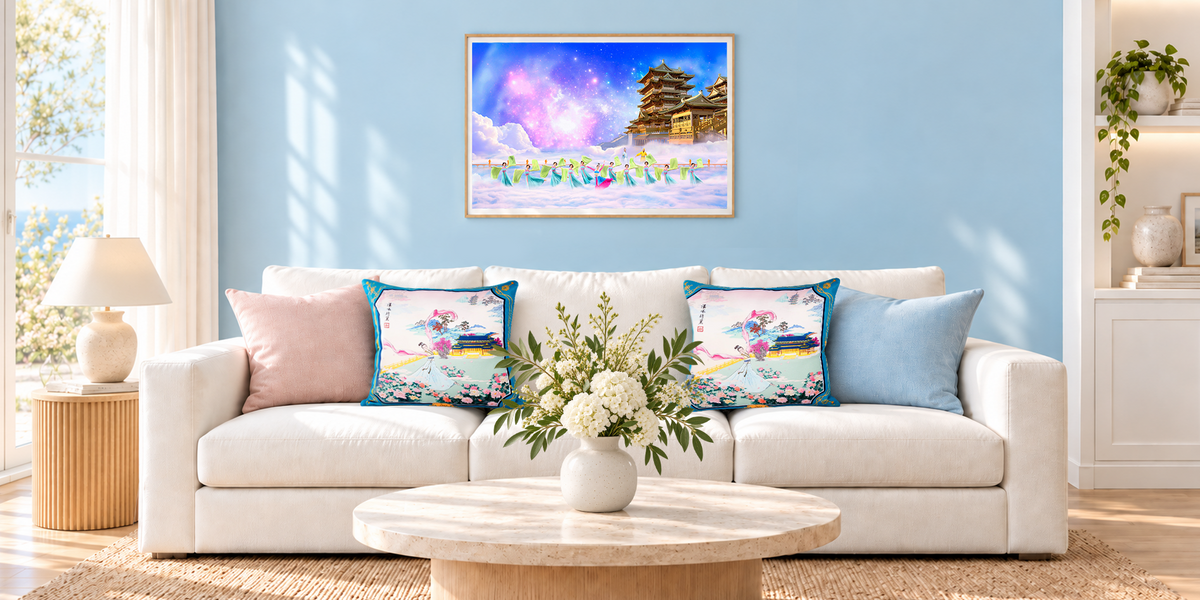


Shen Yun Collections’ New Giclée Print: Visiting the Moon Palace II
On the ideal night of the Mid-Autumn Festival, the air is crisp and the moon shines bright.
For thousands of years, the moon has been more than a luminous presence in the night sky. It has carried with it the Chinese people’s enduring longing for reunion, elegance, and the beauty of the celestial world. Shaped by a culture deeply rooted in the divine traditions of ancient China, generations of Chinese people have long believed that on the moon lies a celestial realm of palaces and immortals.
Legends of the Moon Palace have been passed down through Chinese culture. Traditional Chinese lore is filled with stories of immortals descending to the human world, as well as human beings granted glimpses into the realms beyond. Among these timeless legends is the story of Chang’e, the immortal maiden who dwells in a celestial palace upon the moon, accompanied by graceful celestial maidens.
The story takes place on the night of the Mid-Autumn Festival. Tang Emperor Taizong (598–649), one of the greatest emperors in Chinese history, gazed into the autumn sky and raised his cup to the luminous moon, contemplating the mysteries that might lie within it. On a sudden impulse, he left the palace to experience the festivities among the people, accompanied by a Taoist master from his court. It was then that an ethereal maiden appeared before him. What followed became a legend passed down through the ages.
Shen Yun Performing Arts brought this timeless tale to the stage in its 2019 production, Visiting Chang’e at the Moon Palace. Inspired by the ancient legend, the performance evoked the splendor of an autumn night, the celestial Moon Palace, and graceful maidens dancing among the clouds.
Shen Yun Collections’ new giclée print, Visiting the Moon Palace II, draws directly from the visual poetry of this production. Here, the moon becomes a gateway to a celestial realm, its graceful radiance spreading quietly over the world below.
A Journey to the Moon Palace
The upper half of the composition opens onto a deep blue night sky scattered with stars. The blue gradually melts into violet, then blushes into soft pink before gathering into a luminous glow above the sea of clouds—as though the heavens themselves were slowly unfolding.
Below stretches an endless sea of clouds. White clouds are touched with delicate shades of lavender and pale gold, layered one upon another until they fill the foreground and disappear into the distance.
On the right rises a magnificent celestial palace. Its sweeping eaves ascend in graceful tiers, while jade-green glazed tiles meet warm ochre-gold beams and intricate architectural details. Balustrades, covered walkways, and stone steps unfold one after another, extending beyond the edge of the painting, as though inviting the viewer to follow the path deeper into the celestial palace.
Above the clouds, more than a dozen celestial maidens stand along the balustrade, in the midst of a graceful dance. Dressed in blue-green flowing gowns with pink sashes, they lift long ribbons of pale green into the air.
That delicate green is especially striking against the painting’s rich blues, violets, and golds. Rising and falling with the dancers’ movements, the ribbons weave across the clouds like a living landscape.
At the center, the leading maiden raises both arms high, her skirt unfolding in vivid shades of rose and sapphire blue. The brilliant colors seem to soar with her movement, bringing a touch of vibrant elegance and vitality to the tranquil celestial scene.
Near the stone steps stand two visitors to the Moon Palace: a Taoist master in a flowing pale-blue robe and a human emperor dressed in luminous golden-yellow robes. Together, they quietly connect the human and celestial realms—the emperor and Taoist standing peacefully are juxtaposed with the dancing maidens and boundless clouds. The visitors are still; the dancers are in motion. One group is quiet, the other graceful and fluid. Their contrast creates a sense of perfect harmony, a moment so serene that the viewer may find their own thoughts beginning to settle.

Where Is the Moon?
Curiously, the moon itself does not appear in the painting. And yet, there is no doubt that it is there and provides the setting.
Stars, clouds, celestial palaces, music, and dance—the realm that ancient people looked toward year after year, yet could never fully see, is brought vividly before us here.
Perhaps it is precisely because the moon is not shown that the composition feels even more expansive. The moon is no longer simply a distant sphere hanging in the night sky. Instead, it becomes a doorway to another realm.
Pause before the celestial maidens. Follow the graceful movement of their dance. Let your eyes wander beyond them toward the vast sea of clouds and distant starlight. Perhaps you will discover a sense of serenity and belonging that feels strangely familiar.
Styling the Celestial Scene
The Visiting the Moon Palace II giclée print from Shen Yun Collections is produced on museum-grade Hahnemühle Museum Etching paper using fine art giclée printing. The process captures the artwork’s rich colors, delicate details, and subtle layers, making it a beautiful choice for both collecting and refined interior display.
The horizontal composition and luminous colors of Visiting the Moon Palace II Giclée Print make it especially well suited for the wall behind a sofa, above a long console or dining table, or as a focal point along a hallway. Give the artwork enough horizontal space to breathe, allowing the graceful figures dancing among the clouds to unfold in full.
Whether displayed in a living room, study, or bedroom, it pairs beautifully with clean-lined wooden furniture and soft lighting, creating an atmosphere that is serene, elegant, and poetic.
This giclée print is ideal for a minimalist, refined interior with an understated Eastern aesthetic. A backdrop of ivory, light gray, or pale wood allows the purple, teal, and gold tones of the artwork to speak for themselves. Avoid surrounding it with overly vivid décor; gentle lighting will allow the subtle starlight within the scene to appear even more radiant.
During the Moon Festival, consider placing a small lantern or a delicate arrangement of flowers beside the artwork, allowing the timeless atmosphere of the Moon Palace to naturally become part of your home.
On the night of the full moon, look up at the moon. Then pause for a moment before the painting. Perhaps the inner meaning of the celestial Moon Palace that generations of Chinese people have gazed upon is, at this very moment, right before your eyes.
You May Also Like
Leave a comment