


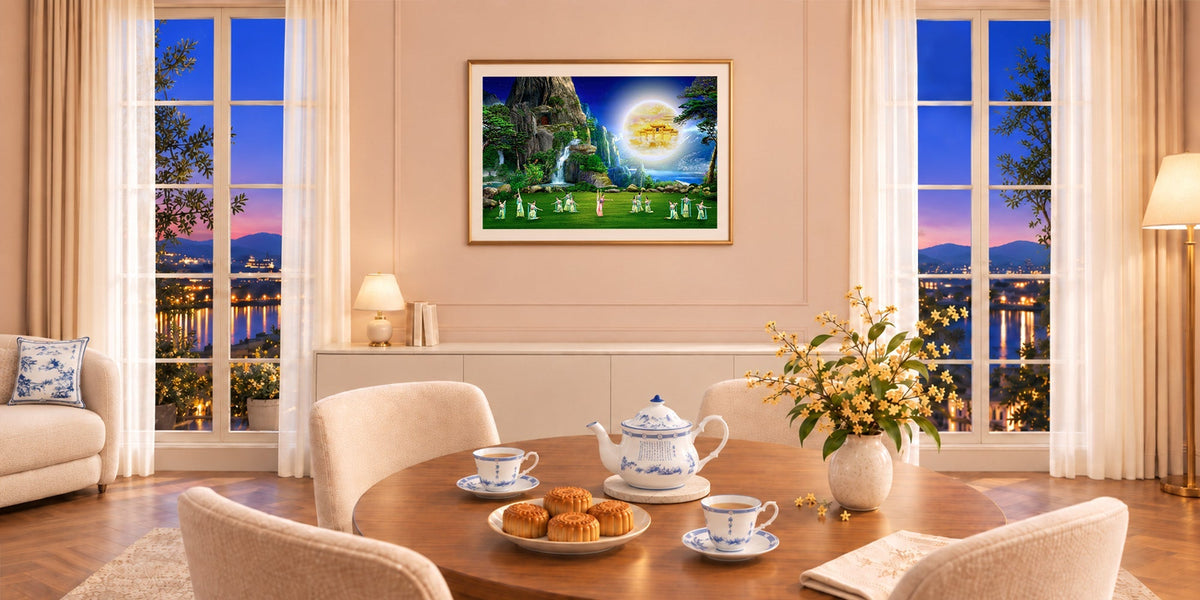


Shen Yun Collections‘ Latest Giclée Print: The Moon Palace Graces the Earth
Mid-Autumn has come again. As the full moon rises, we find ourselves gazing a little longer than usual, wondering what lies deep within that silver light—perhaps the tiered halls of the Moon Palace, the cassia tree that never withers, or the fine dust stirred up as the Jade Rabbit pounds its elixir? The brighter the moonlight, the closer that celestial palace seems, and yet no less out of reach.
The giclée print The Moon Palace Graces the Earth draws its inspiration from Shen Yun’s onstage depiction of the lunar realm in its fabulous dance dramas.
Shen Yun follows in a long line of artistic pieces that focus on the moon and contribute to a rich mythological and spiritual tradition. This culture especially includes one figure: Chang'e, who drank an elixir that took her away from her lover and forever kept her in the Moon Palace. For centuries, this lady of the moon has appeared in the writings of China's poets.
The Tang poet Li Shangyin wrote in his poem: "Chang'e must regret stealing the elixir—now, night after night, her heart in the blue sea and endless sky."
Other mythological denizens of the moon include the white rabbit making a Taoist elixir. Another Tang poet Li Bai wrote: "The immortal lets his two feet hang down, and how round the cassia tree grows. The white rabbit has finished pounding the elixir—for whom, I wonder, is it meant?"
For centuries, the Moon Palace could only be imagined through poetry. In The Moon Palace Graces the Earth, Chang'e and her fellow celestial maidens descend from that palace and dance among the landscapes of the mortal world, casting a gentle radiance over the earth.

On the right, a full moon hangs in the sky, its clear light spreading across the land. Clouds turn within it, and a golden palace emerges from the depths of the glow—eaves layered one above another, radiant with celestial light. The Moon Palace (or Guanghan Palace), known until now only through legend, stands close enough to see.
On the left, a cliff rises into the night. Pines twist along its ridges, and soft moss lies upon the stone. Several waterfalls fall from between the rocks, their mist drifting upward through immortal mountains. Beyond, the lake glimmers a deep blue, and range after range of mountains fades toward some unknown end.
Below the cliff lies a broad expanse of green. More than a dozen celestial maidens are scattered across it, dressed in pale yellow and soft green gowns, with blue-green pibo silk draped over their shoulders and arms, lifting as they move. Some bend low with sleeves trailing, some extend to the side, some raise both arms high; their robes billow and their steps are light as wind. Chang'e, the lady of the Moon Palace, wears pink, one hand raised high and the other gently extended, radiant amid all that green.
The deep blue of the night sky, the gray-green of the rock, the emerald of the grass, and the warm gold of the moon are woven together, and the maidens' pale gowns rest upon the lawn like starlight fallen from above. From the dancing figures in front, to the cliffs and waterfalls beyond them, to the distant lake and moon, the space opens layer upon layer until heaven and earth feel wide.
Viewed in stillness, the painting carries a sense of breadth and calm. The cliff stands tall, the moon hangs high, the springs run on, the maidens dance—all in silent harmony. A clear light falls upon the world below, and trees, mountains, waters, and dancers rest together within it. The heart settles along with them.
Placed in a home, this piece is more than a painting of a moonlit immortal realm. It becomes a world you can stand before and take in. Each viewing may reveal something new: the outline of the palace within the moon, the layers of a falling stream, the curve of a dancer's arm.
What makes a painting worth returning to is often not what it says, but what it leaves unsaid. How does one reach the Moon Palace? What music is playing now? Where in the world are these mountains and waters? The painting leaves room for such questions, so that every viewing becomes a fresh encounter.
Styling Tips
This is an open composition with clear near and far distances, and it needs a wall that can hold the eye. An entryway works well: you open the door and are met by moonlight and mountains, and the weariness of the day settles before you have taken off your coat. A bedroom wall above the headboard, or a tea room, suits it just as well; the stillness of the painting belongs in such spaces.
Hang it at eye level, so the moon falls just where your gaze naturally rests. Keep the surrounding wall clear and hang nothing else beside it—the moonlight needs space in order to properly glow.
Lighting deserves some thought. A soft, warm light angled from the side will bring out the texture of the halo and the falling water, while a strong light aimed straight at the painting will flatten the deep blue of the night sky. If the room already holds greenery or natural wood furniture, the mountains and trees in the painting will answer them, and the whole space will feel that much cooler and calmer.
You May Also Like


Visiting the Moon Palace Giclée Print


Song of Purity and Peace Giclée Print


