

Water Sleeves: Beauty That Has Flowed Through the Ages
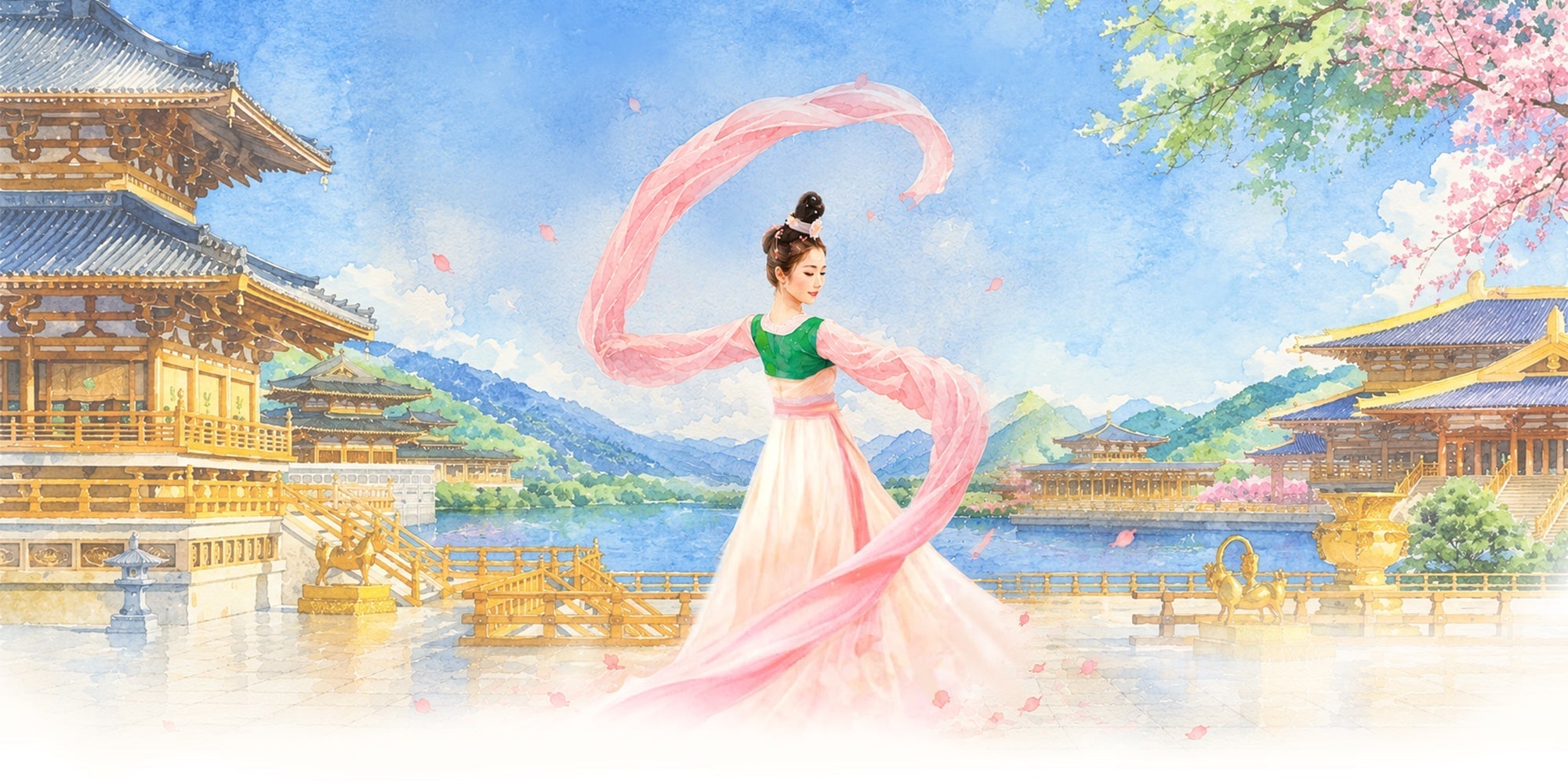
The curtain slowly rises. A long silk sleeve is cast into the air, unfurling like rolling clouds, flowing like rippling water, tracing a graceful arc across the stage before drifting lightly back to the dancer's wrist. In that single gesture of casting out and gathering in, the rosy clouds of a beautiful vista and the visual poetry of dance seem held at once in the palm of a hand. This is the Water Sleeves dance that has captured the hearts of countless audience members on the Shen Yun stage.
Shen Yun's Water Sleeves
"The wind lifts her celestial sleeves, fluttering as they rise, as if she still performed the dance of Rainbow Skirt and Feathered Robe," so Bai Juyi described a celestial maiden in his poem Song of Everlasting Sorrow. These lines hint at the celestial beauty that performers with water sleeves have tried to capture in their performances throughout Chinese history.
To bring audiences the vivid colors and floating texture of the sleeves in motion, Shen Yun's water sleeves are made entirely of pure silk, many of them using a unique hand-dyed gradient technique. Shen Yun's water sleeves are far longer—and far more flowing—than the water sleeves familiar from Peking opera. Nor are they the white of Peking opera's sleeves; instead, they bloom in brilliant, multicolored hues.
To Shen Yun's dance artists, the water sleeve is an extension of the body. As a dancer casts the sleeve out, her spirit and intention flow through it from beginning to end; as she gathers it back, she waits for the sleeve to return naturally to her side before lightly catching it. This precise, intuitive control can only be achieved through arduous years of practice.
The History of Water Sleeves

Dancing with long sleeves has been recorded at least as early as the Zhou Dynasty (1045–256 BCE). Long-sleeve dances—particularly as performed by women—appear clearly in the texts and material imagery of the Western and Eastern Zhou. These Zhou-era dances are believe to have been largely employed in sacrificial rites and ceremonies.
Later, the "long-sleeve dance" flourished in the Han Dynasty and is depicted in a great many images and sculptures of the period. Sleeve movements of this era were an integral part of early ritual and court dances, used on ceremonial occasions. From these we can see that the long sleeves in dance were, at first, not merely for entertainment, but a ceremonial language for communing with heaven and earth and honoring the divine.
At the height of the Tang Dynasty, the water sleeves dance was a form of court entertainment. Tang poets sang often of dancing sleeves: Liu Fangping wrote, "Teartracks stain the well railing—for whom do the dancing sleeves grow long?"
In the Song dynasty, court dancers dispersed among the common people, spurring the growth of folk song and dance, from which the art of opera was born. Sleeve dances passed out of the realm of dance alone and merged into the operatic art that integrates song, speech, acting, and combat, becoming a highly distilled means of expression and a distinctive technique: the water sleeves. The water sleeves refers to the lengths of silk added to the front of an opera character's sleeves; through its various techniques, a performer expresses a character's nature and conveys emotion.
On today's Shen Yun stage, the Water Sleeves dance is celebrated as one of the most beloved pieces among audiences. The dancing sleeves carry different meanings in different dance forms: in the Tibetan dance, the long sleeves express reverence for the divine, while the Water Sleeves dances of the imperial court call for a dignified, noble bearing.
Flying Sleeves Collection
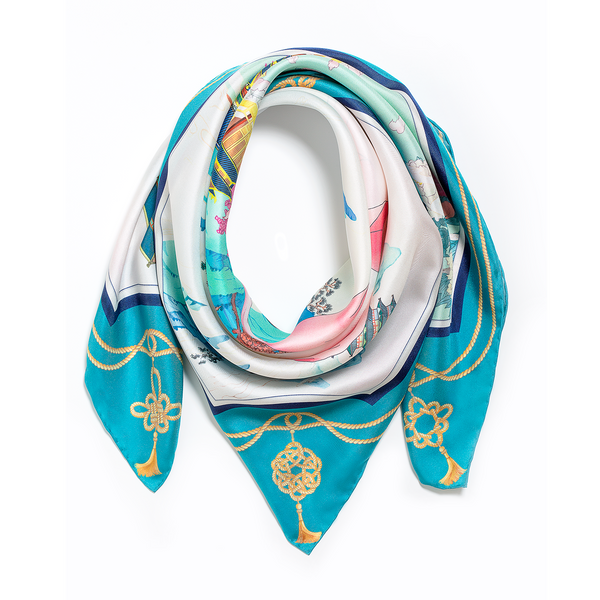
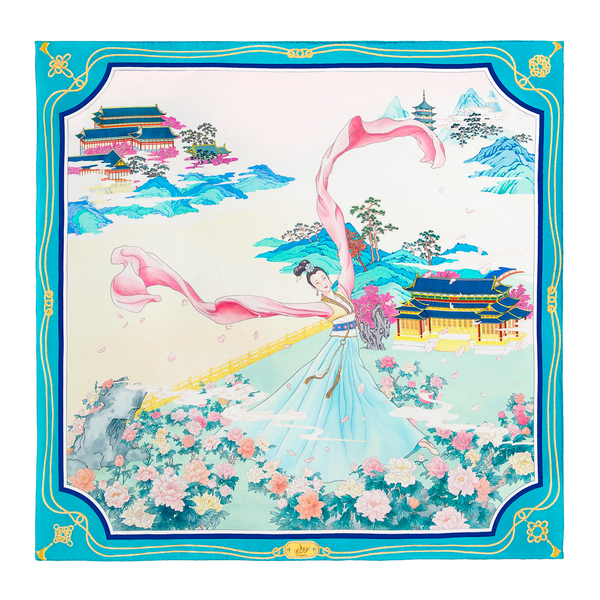
From the ritual sleeves of the Zhou, to the courts and operas of the Tang and Song, to the gracefully flying, multicolored sleeves on the Shen Yun stage today, water sleeves carries within it an aesthetic and a spirit unbroken across five thousand years of Chinese civilization. Now this flowing beauty no longer lingers on the stage alone—the Flying Sleeves Collection from Shen Yun Collections draws its design inspiration from Shen Yun's water sleeves dances.
The radiant brilliance and dancing grace of water sleeves is ready to flow into your everyday life—to travel with you, and to delight the eye wherever you go.