

Rich and Thunderous: The Culture of Drums in Chinese Civilization
When a chorus of drums resounds across the Shen Yun stage, each thunderous beat seems to vibrate straight to the heart. The drum is one of the oldest sounds of human civilization. It is more than a musical instrument—in China the ancients revered it as a “sacred vessel that reaches Heaven”: something that could carry a message up to the heavens, stir the human spirit below, and make evil tremble at its sound.
Following the long river flowing with 5,000 years of continuous Chinese culture, the story of the drum goes right back to the very fountainhead of its civilization: the Yellow Emperor.
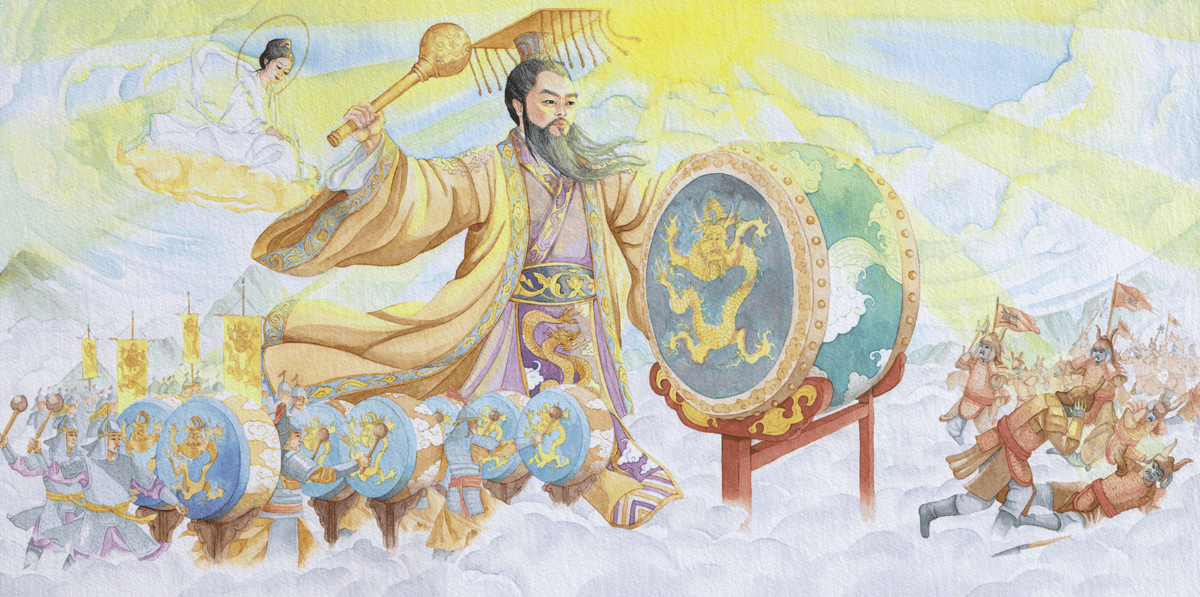
The Yellow Emperor's Kui-Ox Drum
Legend tells that the Yellow Emperor governed all under Heaven, and only Chiyou, chieftain of the Nine Li tribes, remained defiant. Chiyou and his eighty-one brothers had heads of bronze and brows of iron, fierce beyond compare. The two armies clashed on an open field, where Chiyou worked his dark arts and conjured a vast fog that did not disperse for three days. The Yellow Emperor's troops lost their bearings and were surrounded.
At this desperate hour, the Lady of the Nine Heavens taught the Yellow Emperor how to make a drum out of two extraordinary creatures. The surface of the drum came from the skin of the Kui, a creature shaped like an ox, but hornless and one-legged. The mallet for striking the drum came from the bones of the Thunder Beast, which had the body of a dragon and the face of a man—this creature delighted in slapping his own belly, and with each slap came a crash of thunder.
From these components, the Yellow Emperor fashioned eighty drums. Records indicate that these drums shook the land for hundreds of miles around.
When the Yellow Emperor re-formed his ranks and ordered the eighty sacred drums to sound, in an instant Heaven and Earth trembled and the roar was like eighty thunderbolts crashing at once. Chiyou's great army was struck senseless by the earth-shaking drumbeats, unable to move. Through nine successive rolls of the drums they could not flee. At last the Yellow Emperor captured and slew Chiyou, unified the tribes of the Chinese heartland, and raised the curtain on 5,000 years of Chinese civilization.
From then on, the drum became indispensable on the battlefield. It could command the advance and retreat of the armies, and more importantly could rally troops’ morale and inspire their hearts.
Banishing Evil with Thunder
The ancients believed that the drum's sound could frighten evil away. The drum was viewed as akin to thunder, which itself was a demonstration of the majesty and might of Heaven. Thunder, usually accompanied by heavy rain, was a force capable of washing away filth and enforcing divine justice. Traditionally, evil spirits fear it, while those who hold righteous thoughts feel their spirits lifted and their courage redoubled when they hear it. A single drum is like inviting Heaven's thunder down into the human world.
The positive influence of drums meant that they were not just used for war. They were often used at joyous celebrations such as harvest festivals.
Drums also entered the halls of ritual and spiritual cultivation early on. The ancients "beat clay drums with clods of earth," using the simple drums to honor the gods of Heaven and Earth. Daoists regarded the drum as a ritual implement for driving out evil, leading their ceremonies and sacred steps with its beat. In Buddhism the morning bell and evening drum create a steady, far-reaching sound meant to awaken the world from its delusions, calling the heart back toward goodness, and bringing stillness and serenity to the spirit.
Drums on the Shen Yun Stage
On the Shen Yun stage, this ancient power is awakened anew. Over twenty years of performances, a variety of dances have used the rich culture of the drum in military, festive, and spiritual contexts—just as they have been used throughout history.
In the dance drama The Gods Descend to the World, the Holy King—an incarnation of the Creator—leads the divine beings to establish a grand civilization in the mortal world, and the rolling war drums of the royal court's warriors raise the curtain on 5,000 years of civilization.
In A Joyful Harvest, golden wheat fields and earth-shaking drumbeats accompany young men with flower drums tied at their waists, leaping energetically, turning the joy of the harvest into a bold and carefree yangge ethnic dance.
In the Mongolian piece Drums of the Grasslands, the sons and daughters of the steppe leap with abandon, capturing the vastness and valor of the great desert within their drums.
In Tibetan Drums, Tibetan youths bear great drums on their backs and stamp with bended knees, their evil-dispelling beats echoing powerfully across the snowy plateau.
There are also the spirited Northeastern women's waist drums of Northeastern Drummers, and, on the Loess Plateau, the men of the Northwest—white sheepskin towels bound around their heads, dancing with soaring vigor—in the Shaanbei waist drums of Drummers of the Northwest. The dancers’ drumming is simple, unrestrained, and deeply stirring.
The Power of a Drum in a Bracelet
Shen Yun Collections' newest release, the Drum Bead Bracelet, draws its inspiration from those stirring scenes of bold and precise drummers found in Shen Yun performances.
The bracelet centers on a stainless steel drum, symbolizing the upright strength and power of the "sacred vessel that reaches Heaven," paired with a warm-hued strand of 10mm yellow tiger eye stone beads. Tiger eye stones have a flowing golden-brown luster similar to a lion’s fur and have long been regarded as representing lion-like courage and protection.
May this powerful symbol, brimming with righteous spirit, stay by your side, and at every threshold in life, inspire you, like the sound of the drums, to press bravely forward.

Watercolor by Mirage for Shen Yun Collections