




The Culture of the Fan in Ancient China
The fan has a documented history of at least three thousand years in China, tracing its origins back to the legendary era of the Three Sovereigns and Five Emperors.
According to one Tang Dynasty text, the goddess Nüwa "wove grass into a fan to shield her face" before marrying Fuxi, becoming the ancestors of humankind and establishing the customs of marriage. Emperor Shun created the Wuming Fan, meaning "Five Brilliancies," and representing the five directions of east, west, south, north, and center. In ancient paintings, we often see palace attendants holding enormous feather fans symbolizing the emperor's authority.
Because of this noble origin, the fan became an indispensable fashion accessory in the lives of emperors, nobles, and scholars. The Tang Dynasty painter Yan Liben's meticulous "Portraits of Successive Emperors" is especially notable for its depiction of Sun Quan (ruler of the Kingdom of Wu in the Three Kingdoms period) holding a fan made from a deer's tail. Later, this type of fan evolved, replacing the deer-tail hair at its tip with bird feathers, creating a symbolic connection with the sky and heavens.
It was Zhou Yu and Zhuge Liang of the Three Kingdoms period who cemented the feather fan's association with strategic wisdom in later generations. According to the ancient text "Yulin," Zhuge Liang "commanded the three armies with a white feather fan, and the armies followed his every gesture." The white feather fan was the tool with which the reclusive strategist Zhuge Liang directed his campaigns—a light wave of the fan, and it seemed a brilliant scheme would unfold, repelling enemies from a thousand miles away. In this way, the feather fan became an essential prop in the popular imagination whenever a strategist made his entrance.
In Shen Yun's dances for women, elegant maidens in secluded courtyards are often seen holding round fans—a classic fan shape in Chinese history. Because of its resemblance to the full moon, it carries connotations of longing and reunion, and is also known as the "round fan" or "palace fan." The Southern Dynasties poet Liu Xiaowei's speaks of "threading a double-eyed needle to mend a fan of joyful union," referring to this type of round fan. It also went by the name “wan fan,” and the Song Dynasty poet Li Qingzhao mentions "inscribing poetry on a wan fan" in her poem.
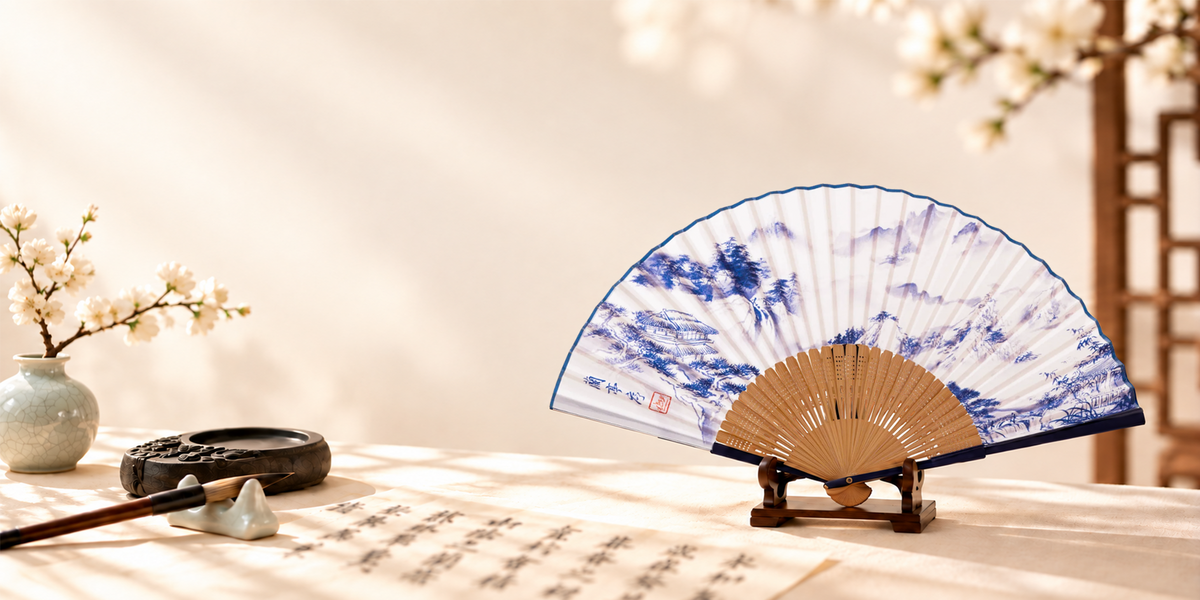
The folding fan seen in Shen Yun's dances for men is the most common type of fan today. Whether it's the striking iron fan carried by a Qing Dynasty imperial guard or the scholar's fan used in place of a writing brush in Poets of the Orchid Pavilion, both are classic, unforgettable moments onstage. The folding fan became popular during the Ming and Qing Dynasties and was an essential accessory for scholars and refined gentlemen. When holding the fan, etiquette dictated that the fan's face should point toward the guest and its back toward oneself—a gesture of humility showing respect for the guest over the host.
In ancient China, the fan was also a medium for poetry and painting. The Eastern Jin calligrapher Wang Xizhi once inscribed characters on the fans of an elderly woman selling them at a bridge in Shaoxing, causing her fans to sell out instantly—a story still celebrated today, and the bridge itself came to be known as "Inscribing Fan Bridge." Renowned painters and calligraphers throughout history also frequently used the fan's surface as a canvas: the Northern Song literary giant Su Shi once casually painted trees, rocks, and other natural scenes on a set of plain, unsold paper fans, instantly transforming them into sought-after treasures. From the round fan to the folding fan, this small surface carried countless poems and exquisite brushwork across the centuries. Regarded by generations of scholars as a "refined treasure carried in one's sleeve," the fan became a uniquely distinguished category within the art of Chinese painting and calligraphy.
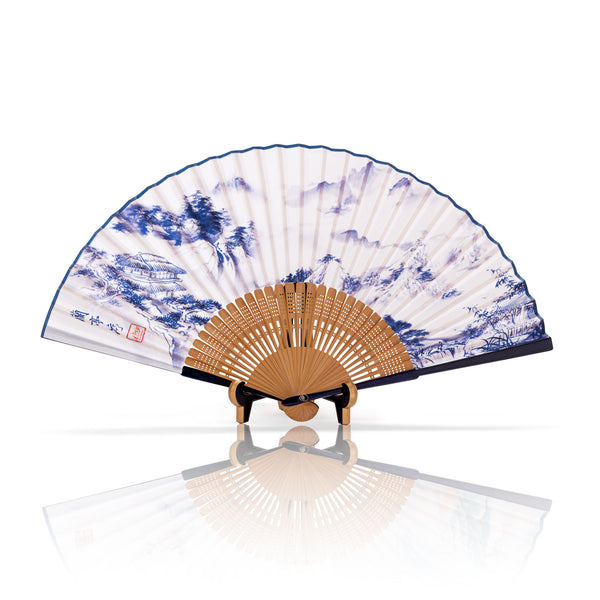
Carrying on this tradition, Shen Yun Collections' Radiant Fan jewelry set, Floral Fan jewelry set, and bamboo fans extend the beauty of Shen Yun into the graceful form of the fan—with hopes of bringing blessings and a touch of artistic beauty into every day of your life.
You May Also Like




Leave a comment


