


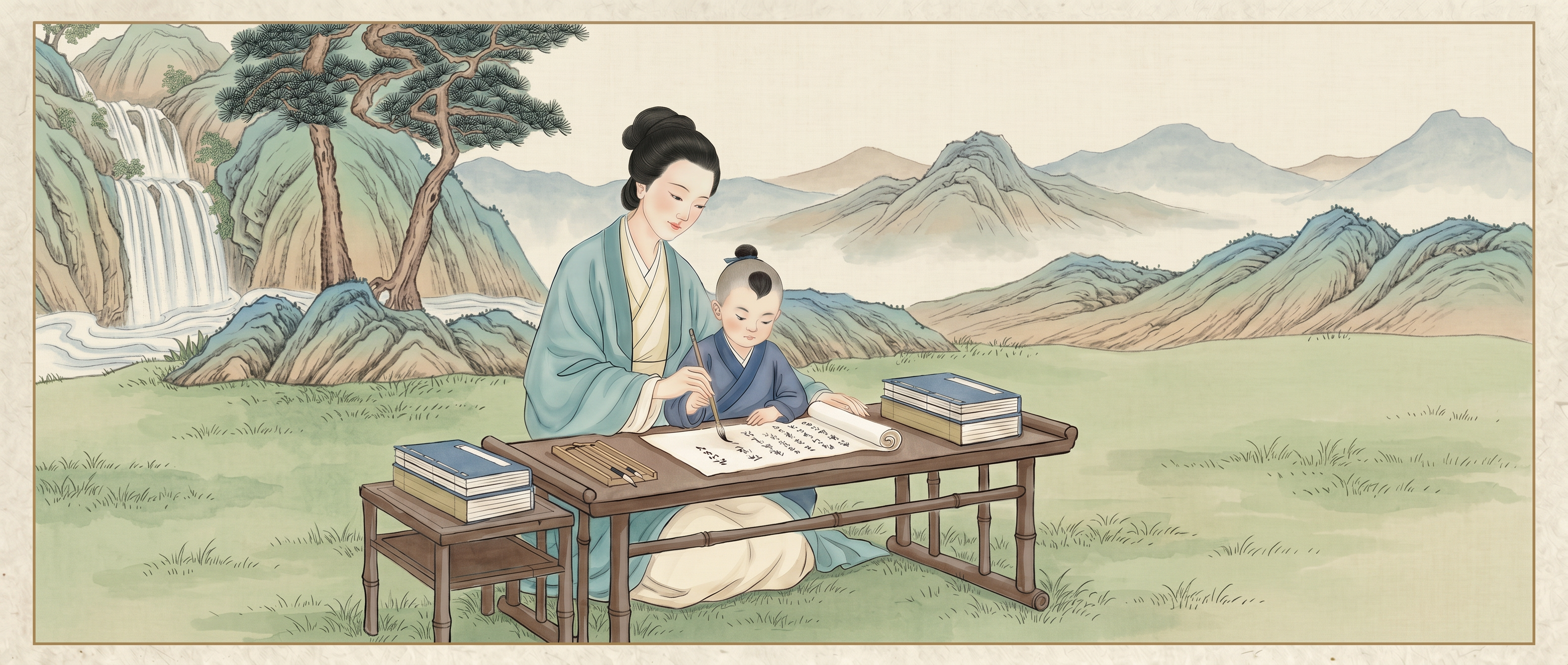


The Virtues of a Mother in Chinese Civilization
Each May, when the lilacs, peonies, and tulips quietly bloom and Spring is in full swing, one figure comes into full bloom—often the most tender and most enduring presence in our lives: Mother.
Across five thousand years of Chinese civilization, mother has never been merely a role. She is a way of life, an ideal to be aspired to and one day achieved. This Mother's Day, let us follow the footsteps of the ancients, and rediscover the depth of what it means to be a mother.
The Ceremony of Motherhood
In the ancient Book of Songs, the poem “Liao E” preserves one of the most moving passages in Chinese literature:
My father gave me life, my mother nurtured me.
She soothed me, she fed me, she raised me, she reared me,
She watched over me, she returned to me,
She held me close wherever she went.
To repay such kindness—the heavens themselves could not contain it.
The father gives life; the mother sustains it, as this passage illustrates. Such motherly grace is something mothers aspire to and the natural inclination to repay mothers is also enshrined as a noble ideal, sanctioned by the heavens.
The Book of Rites speaks further of a mother's role in her child's upbringing: from diet and daily habits to speech and conduct, the mother is the child's first teacher. What Confucians call Mu Yi —"The Ceremony of Motherhood"— is not only giving birth, but the quiet example of a life lived in virtue.
This traditional ideal is engendered by famous mothers in Chinese history such as the mother of the sage Mencius. She moved three times to find the right neighborhood for her son. The mother of scholar Ouyang Xiu was too poor for paper, so she taught her child to write in reeds and sand. The mother of military hero Yue Fei inscribed four characters upon her son's back —translated into English they read “Serve the Country with Utmost Loyalty.”
These stories, cherished across the centuries, speak one eternal truth: a mother's virtue shapes a child's entire life.

The Mother of the Buddha
Queen Maya, mother of Prince Siddhartha Gautama, later known as Buddha Shakyamuni, is one of the most sacred maternal figures in all of the Buddhist scriptures. (Buddhism entered China about 2,000 years ago, during the Han Dynasty, and flourished there.)
Legend tells that while Maya was with child, she dreamed of a six-tusked white elephant descending gently from the heavens and entering her side—a miraculous sign of the Buddha's coming into the world. Throughout her pregnancy, her heart was serene and filled with compassion; even the grasses and trees she passed seemed to grow greener in her presence.
Though Queen Maya departed this world seven days after the birth and ascended to the heavens, the Buddha, upon attaining enlightenment, is said to have risen to that celestial realm to teach for three months—repaying his mother's kindness.
In the Buddhist view, a mother's love is associated with the compassion of a Bodhisattva. Guanyin, the Bodhisattva of Compassion, is also called Ci Mu Guanyin—"The Merciful Mother."

This Mother’s Day
This Mother's Day, may we offer her not only flowers or gifts, but a grateful heart enriched by the wisdom of history. To the woman who gave without measure, a single quiet word can be enough:
Thank you.
At Shen Yun Collections, we believe that true beauty flows from inner virtue. May every gift you choose for your mother carry this reverence that spans centuries and cultures. Such beauty and meaning are timeless and universal.
This Mother's Day, choose a gift that holds the grace of a divinely inspired civilization. May every piece you select at Shen Yun Collections be like that love itself—gentle, enduring, and deep.


