


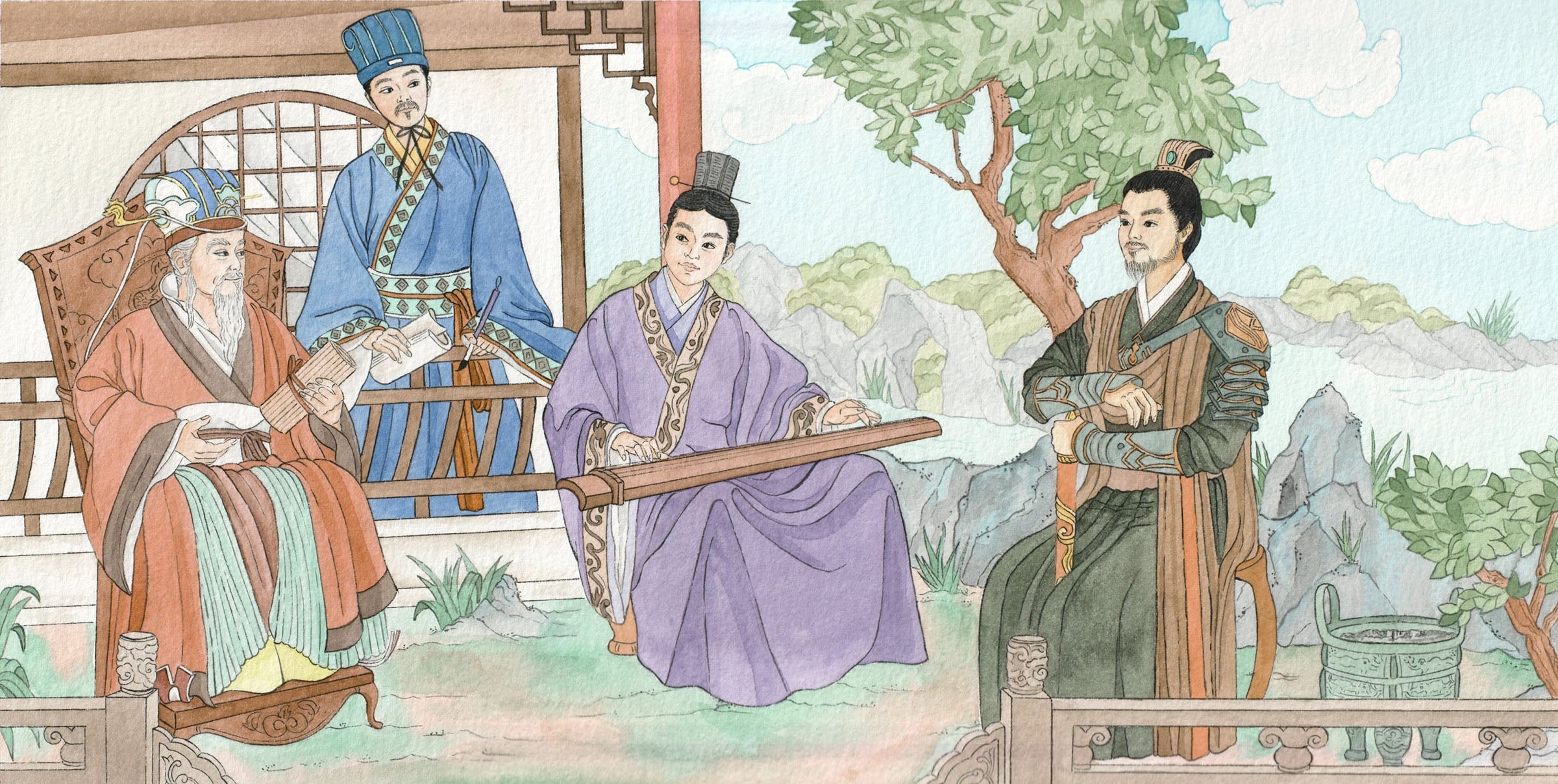


The Tao of Fatherhood: King Wen of Zhou
In the grand epic of Chinese history, fatherhood is a revered institution at the center of social stability and key to the workings of the universe.
The Book of Changes, or I Ching, declares: "When the father is truly a father, and the son truly a son... the way of the family is upright; and when families are upright, the world itself finds peace."
The Classic of Filial Piety adds: "The way of father and son is rooted in Heaven's nature."
One of the fathers that stands out in Chinese history, and who was especially highlighted by Confucius, was King Wen of Zhou.
Ji Chang, the Wise Lord
In the eleventh century B.C., on the plains of Zhou, lived a feudal lord named Ji Chang—known to history as King Wen.
He was a regional governor in the western reaches of the Shang Dynasty. His territory was modest. His army was small. Yet across the land, he was regarded as the very image of virtue. So great was his moral reputation that the tyrant King Zhou of Shang grew uneasy and imprisoned him at Youli for seven long years.
King Wen had ten sons. The eldest, Boyikao, was renowned for his benevolence and devotion. The second, Ji Fa, would one day become King Wu—founder of the Zhou Dynasty (which indeed replaced the Shang Dynasty). The fourth, Ji Dan, became the Duke of Zhou—the architect of many of the rituals and music that laid the foundation of Chinese civilization itself. The other sons, in their own ways, all rose to greatness.
In later centuries, scholars asked: how could a single household produce so many men of such virtue? The answer was not in the sons, it was in the father.
The Book of Songs preserves a verse in praise of King Wen's home: “He set the example for his wife, extended it to his brothers, and so governed family and state.”
King Wen would visit his own father, King Ji, to inquire after his health and meals. When his father seemed unwell, King Wen’s face would appear deeply concerned. When his father was at ease, only then would he allow himself to smile. His children grew up watching this care and devotion.
The most moving moment of King Wen's life came during seven years in prison. These were years of heart-wrenching sorrow. The tyrant King Zhou—to test the depth of King Wen's restraint—had Boyikao, King Wen’s eldest son, killed. The young man's flesh was made into a stew and delivered to King Wen's cell. King Wen knew the truth, and yet, with tears held inside, he ate to protect the lives of his remaining children and the people of his homeland. Such torment lies beyond what most could bear.
But King Wen did not become bitter or hopeless. Within those prison walls, he turned to the eight trigrams of antiquity and unfolded them into the sixty-four hexagrams of the I Ching—leaving behind for all who would come after a profound classic that probes the patterns of Heavenly and Earthly events.
After seven years, King Wen was released. His son Ji Fa carried forward his father's vision— founding the Zhou Dynasty, a reign that would endure for eight centuries and gave birth to many of the rituals and music at the heart of Chinese civilization.
Three thousand years have passed, yet the lessons left by King Wen endure. The greatest gift a father can give his child is to let them see what virtue looks like. It is the father's reverence for his elders, his respect for his wife, his humility in success, his composure in hardship, and his choice to do what is right, even when no one is watching or expecting it. That is the Tao of Fatherhood as taught through the actions of King Wen of Zhou.
You May Also Like



A Passage in Time Briefcase - Brown


